

Why Fresh Motor Oil is Critical for Your Chevrolet Engine
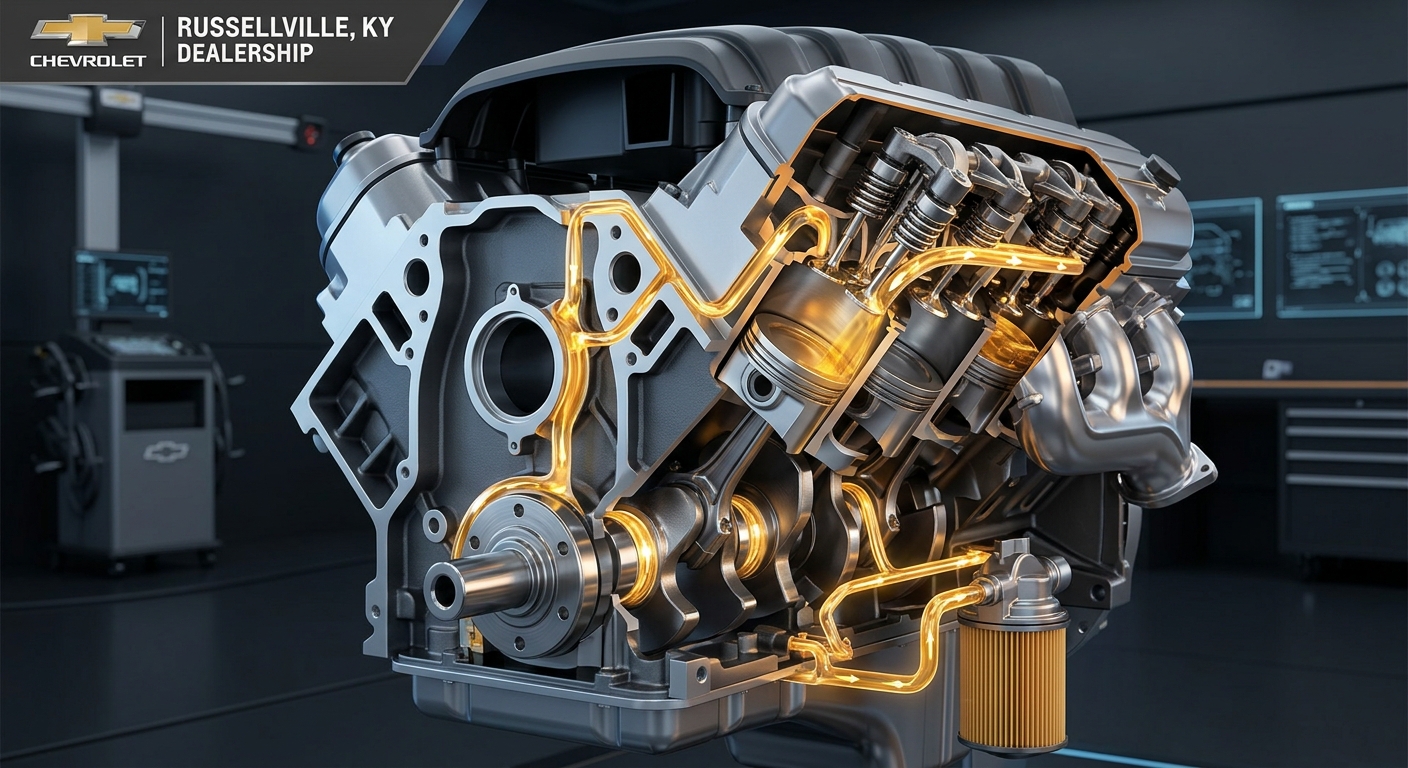
An internal combustion engine relies on a complex network of moving metal components operating under extreme heat and pressure. Motor oil’s primary job is to maintain a protective lubricating film between these rapidly moving parts, preventing direct metal-to-metal contact. Without this barrier, components like pistons, camshafts, and valves would grind together, creating intense friction that causes immediate, catastrophic engine wear. Over time, as oil is subjected to the high temperatures of combustion, it naturally breaks down, losing its viscosity and film strength.
Beyond lubrication, fresh motor oil serves as a vital secondary cooling agent. While the vehicle radiator and coolant system regulate the upper portion of the engine block, circulating oil absorbs intense thermal energy from the pistons, bearings, and crankshaft. It carries this heat down to the oil pan, where it dissipates into the passing air. If the oil is allowed to degrade, thicken, or oxidize, its heat-transfer capability drops significantly, leaving critical engine internals vulnerable to localized overheating and warping.
Engine oil also acts as a continuous cleaning agent. As it flows through the engine, it traps microscopic soot, carbon deposits, dirt, and metal shavings, carrying them directly to the oil filter. Fresh oil contains specialized detergent and dispersant additives that prevent these contaminants from settling and forming a thick, gelatinous sludge. Left unchecked, neglected oil service allows sludge to accumulate, which can block narrow oil passages and completely starve the engine of lubrication.
To keep your powertrain running safely, you can quickly schedule a service appointment online with our factory-trained technicians. For drivers navigating the dusty back roads and rolling hills of the agricultural areas around Elkton, keeping up with these oil changes is especially crucial to prevent airborne dust from contaminating the engine. If you have any questions about the correct oil grade for your vehicle, you can reach our service desk directly at (270) 713-3840 or visit our showroom on Hopkinsville Road to speak with our maintenance experts.
Table of Contents
- How Often Should I Change My Oil for Modern Driving Conditions?
- Comparing Synthetic vs Conventional Motor Oil Options
- Warning Signs Your Vehicle is Overdue for Fresh Lubrication
- How Local Driving Habits and Regional Towing Impact Oil Life
- Common Questions About Engine Maintenance and Oil Health
- Schedule Professional Chevrolet Engine Care
How Often Should I Change My Oil for Modern Driving Conditions?
For decades, the standard advice handed down to drivers was to change their engine oil every three months or 3,000 miles. While that rule was necessary for older vehicle designs and basic lubricants, modern automotive engineering and advanced oil chemistry have made those short intervals obsolete. Today, many manufacturers specify normal-service oil change intervals in the 7,500 to 10,000 miles range, provided the vehicle is using high-quality synthetic lubricants.
Modern Chevrolet vehicles feature a built-in oil life monitor that uses an algorithm to track real operating conditions. Rather than simply counting miles, this system monitors engine revolutions, operating temperatures, short-trip frequency, and engine load to calculate exactly when the oil is nearing the end of its effective lifespan. Following the vehicle’s manual and the dashboard indicator light is the most accurate way to manage your maintenance schedule. However, even if you do not reach the mileage limit on your odometer, motor oil degrades over time due to moisture accumulation and oxidation, meaning most service experts recommend an oil change at least once every 12 months.
Your driving environment plays a massive role in how quickly your oil degrades. Vehicles driven in harsh conditions require more frequent service. Severe driving conditions include:
- Consistent short trips of under 10 miles, which prevent the engine from reaching full operating temperature.
- Excessive idling or driving in heavy stop-and-go traffic.
- Operating in extremely hot or cold climates.
- Frequent towing, hauling heavy payloads, or driving in dusty, off-road conditions.
For example, commuters driving daily to Fort Campbell through the stop-and-go traffic of Clarksville put different stresses on their engines than those taking long, steady highway trips. These urban driving patterns qualify as severe service, meaning the oil should be changed closer to the 3,000 to 5,000 miles mark if using conventional oil, or 5,000 to 7,500 miles if using a blend. If you are looking to upgrade to a vehicle with a fresh maintenance history, you can explore our selection of quality used vehicles, or order components directly through our parts department to handle your own maintenance. You can also visit our homepage to view our current service specials.
Comparing Synthetic vs Conventional Motor Oil Options
Choosing the correct motor oil can feel overwhelming when looking at the variety of options on the shelf. The primary differences lie in how the oils are manufactured, their molecular structures, and how they perform under extreme temperatures. Understanding these differences ensures you select the best level of protection for your specific powertrain.
| Oil Type | Typical Change Interval | Best Suited For | Key Benefits |
|---|---|---|---|
| Conventional Oil | 3,000 to 5,000 miles | Older engines, low-mileage driving | Budget-friendly, basic protection |
| Synthetic Blend Oil | 5,000 to 7,500 miles | Light trucks, SUVs, moderate towing | Improved high-temperature stability |
| Full Synthetic Oil | 7,500 to 10,000 miles | Modern engines, turbochargers, extreme climates | Superior flow in cold, resists thermal breakdown |
| High-Mileage Oil | 5,000 to 7,500 miles | Vehicles with over 75,000 miles | Rejuvenates seals, reduces oil consumption |
Premium conventional oil is refined directly from crude oil and is suitable for older, less complex engines. While it provides adequate lubrication under normal operating conditions, its irregular molecular structure means it breaks down faster than synthetic alternatives, requiring more frequent changes.
Full synthetic oil is chemically engineered in a laboratory to achieve a highly uniform molecular structure. It flows much faster at low temperatures to protect the engine during cold winter starts, and it resists thermal breakdown under the intense heat of summer driving. Many high-tech turbocharged engines explicitly require full synthetic oil to prevent oil vaporization in the turbo bearings.
Synthetic blend oil combines conventional and synthetic base oils. This option provides a middle ground, offering better protection against heat and heavy loads than conventional oil alone, making it a popular choice for light trucks and SUVs.
High-mileage oil is formulated specifically for vehicles with more than 75,000 miles on the odometer. It contains unique seal conditioners that help swell and soften aging rubber gaskets, reducing or preventing slow oil leaks. It also features extra detergents to help clean away historic sludge buildup.
If you are driving an older vehicle and looking to transition to something newer, you can browse our inventory of used vehicles under 30K to find an efficient daily driver. Our finance team can help you easily value your trade-in online to see how much equity you can put toward your next purchase. Once you experience our straightforward process, we invite you to leave us a review to share your feedback.
Warning Signs Your Vehicle is Overdue for Fresh Lubrication
Even when adhering strictly to a recommended maintenance schedule, real-world driving can sometimes degrade motor oil faster than expected. Knowing what warning signs to look for can prevent minor oil issues from turning into major mechanical failures. Regularly checking your oil level with the dipstick is the simplest way to monitor the health of your engine’s lubricant.
The most obvious warning is the dashboard oil change indicator or the check engine light. Modern Chevrolet models, such as the family-ready new Chevrolet Equinox or the hard-working new Chevrolet Silverado 1500, are designed to alert the driver when the oil life reaches a critical threshold. If this light stays illuminated, scheduling service should be an immediate priority. When pulling the dipstick, look at the color and consistency of the oil; healthy oil is a translucent amber color, while old, degraded oil appears dark brown or black and may have a gritty texture from suspended carbon particles.
Physical sounds and smells are also clear indicators of oil breakdown. If you notice a metallic ticking or knocking noise coming from the engine bay upon a cold start, it often means the oil has thinned out so much that it cannot maintain a proper film on the valvetrain. A strong smell of gasoline or burning oil inside the cabin is another red flag, suggesting a potential leak or fuel dilution within the crankcase. Furthermore, degraded oil increases internal engine friction, which can cause sluggish acceleration and a noticeable drop in fuel economy. Keeping fresh oil in your engine can improve fuel efficiency by 12-15% compared to running on neglected, sludge-filled lubricant.
If you are in the market for a new vehicle, you can explore our complete selection of new vehicles, including spacious family haulers like the new Chevrolet Tahoe, to find a model equipped with the latest diagnostic and oil-monitoring technologies.
How Local Driving Habits and Regional Towing Impact Oil Life
When our service team discusses maintenance with truck owners, the conversation often centers on how they use their vehicles day-to-day. For example, owners towing heavy trailers or hauling equipment across local farms often ask why they need to change their oil more frequently than the standard interval, which allows us to explain the thermal breakdown that occurs under sustained heavy loads. Towing a trailer or carrying heavy payloads forces the engine to operate at higher RPMs for extended periods, generating intense heat that accelerates the oxidation of the motor oil.
Dusty environments represent another severe operating condition that is common in rural agricultural areas. Fine dust particles can bypass even high-quality engine air filters over time, finding their way into the crankcase where they mix with the oil to form an abrasive paste. If you frequently drive on gravel or unpaved farm roads, your oil filter will fill with contaminants much faster, making regular oil and filter changes essential to prevent accelerated cylinder wall wear. Short-trip driving also prevents the engine from staying at its optimal operating temperature long enough to burn off internal moisture and fuel vapors that naturally accumulate in the crankcase, leading to rapid oil dilution.
For drivers who rely on heavy-duty performance for work or play, keeping a strict maintenance schedule is the best way to protect your investment. If you are looking for a highly capable vehicle for your towing needs, check out our inventory of used trucks for sale. To streamline your buying process, you can get pre-approved by completing our online finance application from the comfort of home. We take pride in our transparent service, and we encourage you to read customer testimonials to see how we help drivers keep their vehicles running smoothly.
Common Questions About Engine Maintenance and Oil Health
Q: What happens if I only drive a few thousand miles a year?
Even if you do not hit the mileage threshold on your odometer, motor oil naturally degrades over time. Exposure to oxygen causes the oil to oxidize and lose its chemical stability, while repeated heating and cooling cycles create moisture condensation inside the crankcase. This moisture can mix with combustion byproducts to form corrosive acids that damage internal engine bearings. For this reason, we recommend changing your oil at least once every 12 months, regardless of mileage.
Q: Can I switch from conventional to full synthetic oil on an older vehicle?
Yes, it is perfectly safe to switch from conventional to full synthetic oil in older engines. Modern synthetic oils are fully compatible with older engine seals, and they flow much more efficiently to reduce wear on older components. For older vehicles with significant mileage, switching to a high-mileage synthetic oil is often highly beneficial, as these formulations contain specialized conditioners that help restore hardened rubber seals to prevent leaks.
Q: Does the oil filter need to be replaced with every oil change?
Replacing the oil filter with every oil change is highly recommended. The oil filter’s job is to trap dirt, soot, and metal shavings; over thousands of miles, the filter medium becomes saturated with these contaminants. If you leave an old filter in place, it can become clogged, forcing the oil to bypass the filter entirely through a safety valve and recirculate dirty, unfiltered oil back through your engine.
Q: How does severe cold or heat affect my oil’s viscosity?
Motor oil thickness, or viscosity, changes with temperature. In freezing winter temperatures, oil thickens and flows more slowly, which can delay vital lubrication to the upper engine during a cold start. In extreme summer heat, oil thins out, which can compromise the protective film between moving parts. Multi-viscosity oils, such as 5W-30, are engineered with polymer additives that allow them to flow quickly in the cold while maintaining necessary thickness and protection under high operating temperatures.
Q: What should I do if my oil level is low but it isn’t time for a change yet?
If your dipstick shows that the oil level is low, you should top it off immediately using the exact oil viscosity recommended in your owner’s manual. Driving with low oil reduces the volume of lubricant available to absorb heat, which can cause the remaining oil to overheat and degrade rapidly. However, a dropping oil level indicates that your engine is either burning oil or has a slow leak, so you should have our service team inspect the system.
If you are looking for a stress-free vehicle purchase, discover how to buy online with the Newton Fastpass program. You can also explore the benefits of our certified pre-owned program to find a vehicle backed by a rigorous multi-point inspection, or take a moment to learn about us and our commitment to our customers.
Schedule Professional Chevrolet Engine Care
Protecting the health and longevity of your vehicle requires a proactive approach to routine maintenance. Regular oil changes are the single most effective and affordable way to prevent premature engine wear, maintain optimal fuel economy, and avoid costly mechanical repairs down the road. Our factory-trained technicians understand the exact specifications of your vehicle, ensuring it receives the correct oil grade and high-quality filters required for peak performance.
Whether you are driving a light commuter car, a family SUV, or a heavy-duty work truck, our team is equipped to handle all of your maintenance needs. If you are looking to trade up to a spacious family vehicle, browse our selection of used SUVs to find the perfect fit. To get started on your next oil change, get turn-by-turn directions to our dealership at 452 Hopkinsville Rd, or call our service department at (270) 713-3840 to set up your appointment today.
0 comment(s) so far on Why Fresh Motor Oil is Critical for Your Chevrolet Engine