

Why Clean Airflow Matters for Your Chevrolet Engine
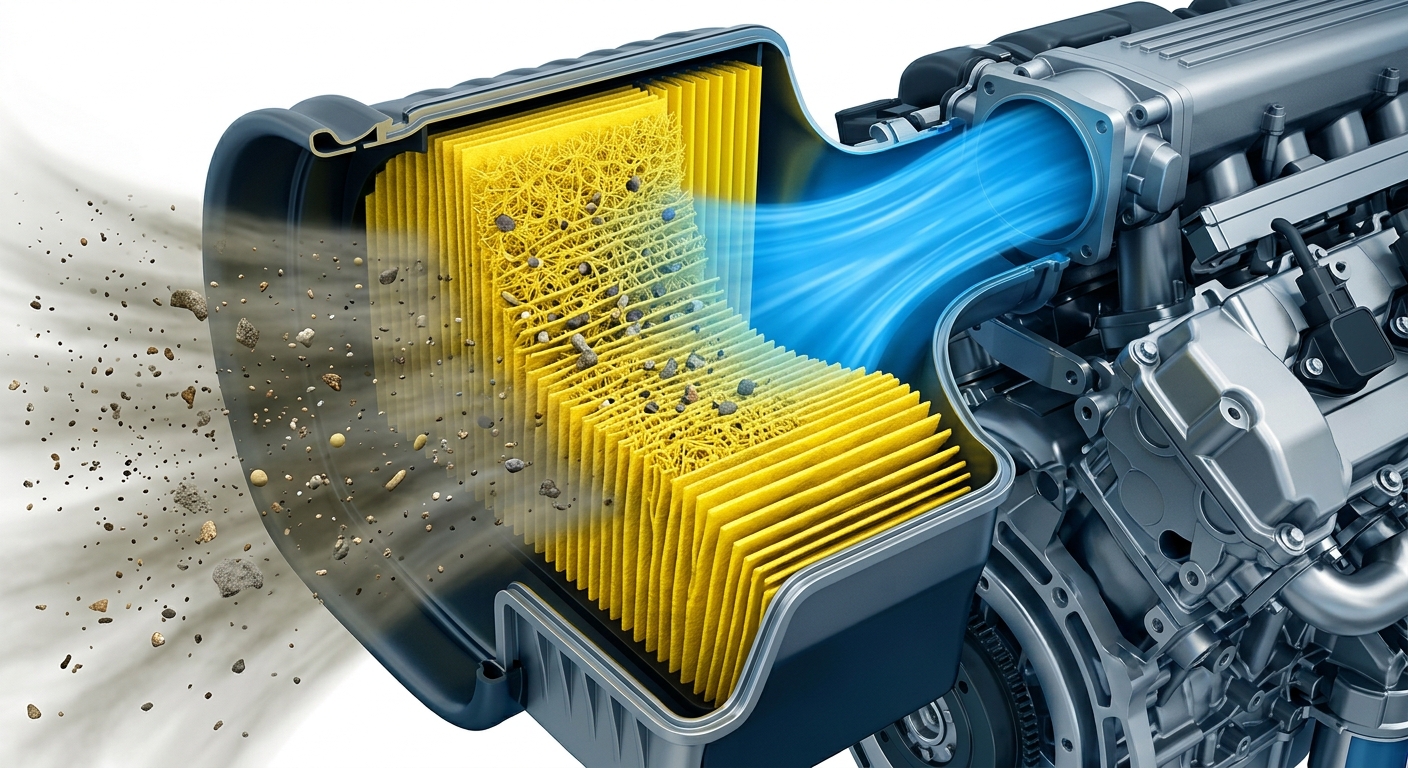
An internal combustion engine requires a precise mixture of fuel and oxygen to generate power efficiently. To visualize this relationship, consider that for every single gallon of fuel your vehicle burns, the engine consumes approximately 10,000 gallons of air. This massive volume of air must be completely free of environmental debris before it enters the combustion chambers. The engine air filter serves as the primary barrier, trapping dirt, road grime, pollen, and microscopic particles so that only purified air reaches the cylinders.
Without this protective boundary, even minuscule contaminants can cause catastrophic internal wear. A single particle as small as a grain of salt entering the combustion chamber acts like an abrasive sandpaper, scoring cylinder walls, damaging pistons, and wearing down vital valves. Over time, this microscopic abrasion degrades engine compression, leads to oil consumption, and can result in premature engine failure. By capturing these elements, a high-quality filter preserves the tight mechanical tolerances of your powertrain.
When a filter becomes clogged, the engine must work significantly harder to pull in the air it needs. This restriction disrupts the delicate air-fuel ratio, forcing the onboard computer to compensate by injecting more fuel, which directly lowers your fuel economy. Routine inspections are the easiest way to prevent these issues. If you want to drop by for a quick inspection, you can easily get directions to our Russellville showroom or give our service department a quick call to speak with a technician about your maintenance schedule.
Table of Contents
- How Dusty Driving Conditions Shorten Your Engine Air Filter Life
- Recognizing the Warning Signs of a Clogged Engine Air Filter
- Engine Air Filters vs Cabin Air Filters: Key Differences to Know
- Choosing OEM Chevrolet Filters vs Aftermarket Alternatives
- Common Questions About Engine Air Filter Replacement Intervals
- Quick Answers Before You Visit
- Schedule Your Professional Chevrolet Maintenance
How Dusty Driving Conditions Shorten Your Engine Air Filter Life
Does driving in dusty areas require more frequent filter changes? The short answer is yes. While standard manufacturer schedules often suggest replacing the engine air filter every 12,000 to 15,000 miles, these intervals assume typical highway and suburban driving. For vehicles operating in highly agricultural areas, such as the fertile farmlands surrounding Elkton, the concentration of airborne dust, dry soil particles, and crop chaff is substantially higher. This heavy concentration of debris can load a filter element in a fraction of the normal time, necessitating replacements as early as every 6,000 to 10,000 miles.
When driving through dusty environments or on unpaved gravel roads, the air intake is constantly bombarded by fine particulate matter. The pleats of a standard paper filter quickly saturate with dust, closing off the microscopic passages designed to let air flow freely. This restricted breathing affects performance across the entire Chevrolet lineup. For example, if you are utilizing the rugged capabilities of a midsize truck, keeping a fresh intake pathway is critical to maintaining the performance of your vehicle. Drivers can explore options like our new Chevrolet Colorado inventory to find models engineered with robust intake systems designed to handle demanding environments.
Similarly, high-volume work trucks face extreme exposure on construction sites and rural access roads where dust is constantly kicked up by heavy machinery. To maintain the maximum torque and payload capacity of a full-size truck, the engine must breathe without restriction. Drivers who rely on these vehicles for heavy hauling can browse our new Chevrolet Silverado 1500 inventory to see trucks built for severe duty, though even these durable engines require more frequent filter swaps when operated in dusty conditions.
Even high-performance sports cars with advanced aerodynamics are susceptible to dust build-up. An unrestricted intake system ensures that advanced performance models receive the precise airflow required to maximize horsepower and throttle response. Enthusiasts looking for cutting-edge engineering can check out our new Chevrolet Corvette E-Ray inventory to see how modern engineering balances power and efficiency, and why clean airflow remains paramount even in advanced electrified performance platforms.
Recognizing the Warning Signs of a Clogged Engine Air Filter
How do you know when your vehicle is struggling to breathe? A restricted engine air filter produces several distinct physical and mechanical symptoms before it causes permanent engine damage. One of the most immediate signs is a noticeable drop in acceleration. Because a modern fuel-injected engine relies on a precise volume of oxygen to generate power, a clogged filter starves the system, making the throttle feel sluggish and unresponsive when passing or merging. Replacing a dirty filter can restore proper airflow and improve acceleration by 6% to 11% on modern fuel-injected vehicles.
Beyond sluggish performance, a restricted intake can trigger the check engine light. When the mass airflow sensor detects that incoming air levels are below expected parameters, or when the oxygen sensors read an overly rich fuel mixture, the vehicle’s computer registers a fault. You might also notice a rough, vibrating idle or unusual engine noises, such as coughing or sucking sounds, as the engine struggles to draw air. In extreme cases, unburned fuel can exit the combustion chamber and cause a strong gasoline smell or dark smoke from the exhaust tailpipe.
During routine maintenance, technicians perform a simple visual test by removing the filter and holding it up to a bright light. If the light cannot easily pass through the pleated paper element, the filter is saturated and must be replaced. For high-performance sports cars, keeping this pathway pristine is vital. Drivers can browse our new Chevrolet Corvette inventory or look specifically at the track-ready models in our new Chevrolet Corvette Z06 inventory to appreciate how unrestricted airflow supports high-RPM performance.
Conversely, fully electric vehicles do not have an internal combustion engine and therefore do not use an engine air filter. If you prefer to skip engine-related intake maintenance altogether, you can explore our new Chevrolet Silverado EV inventory to see how all-electric capability eliminates traditional oil changes, spark plugs, and engine filter replacements entirely.
Engine Air Filters vs Cabin Air Filters: Key Differences to Know
Many drivers confuse the engine air filter with the cabin air filter, but these two components serve completely different systems. The engine air filter is located under the hood inside a sealed plastic airbox and is solely responsible for cleaning the air that enters the engine’s intake manifold. The cabin air filter, typically accessed behind the glove compartment or under the cowl, cleans the air that circulates through your passenger cabin’s heating, ventilation, and air conditioning (HVAC) system.
While a dirty engine air filter degrades fuel economy and acceleration, a clogged cabin air filter directly impacts your comfort and health. When the cabin filter is packed with dust, pollen, and mold spores, the airflow from your dashboard vents is severely restricted. This forces your blower motor to work harder, which can cause the AC system to overwork, reduce cooling efficiency during hot summer days, and lead to musty odors inside the vehicle.
This distinction is highly relevant for family-sized vehicles where passenger comfort and cabin air quality are top priorities. For instance, those interested in a versatile compact SUV can check out our new Chevrolet Equinox inventory, which features a 1.5L engine with a CVT and standard 175 hp, utilizing separate, specialized filters to protect both the engine and the five-passenger cabin.
For larger families who need maximum interior space and cargo capacity, keeping both filters fresh is essential for long road trips. Drivers can browse our new Chevrolet Suburban inventory to find spacious three-row SUVs that offer exceptional comfort, provided the dual-zone climate systems are supported by a clean cabin filter. Meanwhile, drivers of high-end performance models can explore our new Chevrolet Corvette ZR1 inventory to see how advanced engineering isolates passenger comfort from high-output mechanical systems.
Choosing OEM Chevrolet Filters vs Aftermarket Alternatives
When it comes to replacing your filter, choosing Original Equipment Manufacturer (OEM) parts over generic aftermarket alternatives is critical for long-term reliability. OEM Chevrolet filters are engineered specifically to match the exact dimensions, pleat depth, and sealing surfaces of your vehicle’s factory airbox. This precise fit ensures that no unfiltered air can bypass the filter media. Generic aftermarket filters are often designed to fit multiple vehicle makes and models, which can result in slight gaps around the rubber seal, allowing fine dust to slip directly into the engine.
Furthermore, OEM filters utilize high-grade media designed to balance maximum filtration efficiency with optimal airflow. Some aftermarket “high-flow” performance filters achieve greater airflow by using larger pores in the filter media, which can allow smaller abrasive dust particles to pass through. Other reusable oiled filters require precise cleaning and re-oiling; applying too much oil can contaminate the mass airflow sensor, leading to incorrect engine readings and expensive sensor repairs. To get the exact filter designed for your vehicle, you can visit our parts department to order genuine OEM components.
For drivers of all-electric models, cabin air filtration remains the primary filter maintenance item. You can shop our new Chevrolet Bolt EV inventory or browse our new Chevrolet Equinox EV inventory to experience efficient daily driving where the only filter you ever need to worry about is the one keeping your cabin air fresh and allergen-free.
Common Questions About Engine Air Filter Replacement Intervals
A common question we hear from drivers in Franklin, where dusty farm roads and agricultural activities are part of daily life, is how often they should inspect their filters. Under normal driving conditions, checking the filter at every oil change and replacing it every 12,000 to 15,000 miles is standard practice. However, if your daily commute involves unpaved roads, gravel driveways, or heavy stop-and-go construction traffic, we recommend a visual check every 6,000 miles to ensure the pleats are not completely choked with dirt.
To simplify your shopping and ownership experience, we offer tools to streamline your purchase. You can learn about Newton Fastpass to see how our online platform allows you to customize your payments and complete most of the buying process from the comfort of home.
If you are interested in a pre-owned vehicle that has already undergone rigorous inspections, you can learn about our CPO program to see how our certified pre-owned vehicles meet strict manufacturer standards, including fresh filters and fluid checks. To find out more about our commitment to quality and customer service, feel free to learn about us and our dedicated team.
Quick Answers Before You Visit
Q: Can a dirty engine air filter cause my car to misfire?
Yes. When an engine air filter is heavily clogged, it severely limits the amount of oxygen entering the combustion chamber. This creates an overly “rich” air-fuel mixture, meaning there is too much fuel and not enough air, which can foul the spark plugs and cause the engine to misfire or idle roughly.
Q: Is it easy to replace an engine air filter myself?
On most modern Chevrolet vehicles, the engine air filter is housed in an easily accessible plastic airbox under the hood that is secured by a few clips or screws. While many drivers choose to replace it themselves, having a certified technician handle it during a routine oil change ensures the airbox is properly cleaned of debris and the new filter is sealed correctly.
Q: Does a dirty engine air filter affect my car’s air conditioning?
No, the engine air filter does not affect the AC system. The engine air filter only cleans the air entering the engine for combustion, while the cabin air filter is responsible for filtering the air that blows through your vehicle’s climate control vents.
Q: Can I just blow the dust out of my old air filter with compressed air?
We do not recommend cleaning a standard paper filter with compressed air. While it may remove large surface debris, the high-pressure air can tear the microscopic fibers of the paper media, ruining its filtration capability and allowing engine-damaging dust to pass through.
Q: How long does it take for a technician to replace an engine air filter?
At our service center, replacing an engine air filter typically takes less than 15 minutes. It is a quick, routine procedure that can easily be performed alongside a standard oil change and tire rotation.
Schedule Your Professional Chevrolet Maintenance
Keeping your engine’s intake clean is one of the most cost-effective ways to protect your vehicle’s performance, fuel economy, and overall longevity. For drivers navigating the urban streets of Clarksville, stop-and-go city traffic and environmental pollutants can accumulate in your filter just as quickly as rural dust, making regular inspections highly beneficial. Our factory-trained technicians can quickly inspect your engine and cabin filters to ensure your vehicle is running at peak efficiency.
If you are ready to book your next routine service or need a multi-point inspection, you can easily schedule a service appointment online. Our team is equipped with genuine OEM parts designed specifically for your model’s powertrain.
For any questions about replacement intervals, parts availability, or general maintenance, feel free to give our service department a quick call. If you prefer to drop by in person, you can get directions to our Russellville dealership at 452 Hopkinsville Rd, Russellville, KY 42276. We look forward to helping you keep your Chevrolet in peak operating condition for miles to come.
0 comment(s) so far on Why Clean Airflow Matters for Your Chevrolet Engine