
Understanding 2023 Chevrolet Tahoe Fuel Tank Replacement Costs
Replacing a fuel tank on a modern full-size SUV is a significant maintenance event that involves both specialized components and precise labor. For owners of the 2023 Chevrolet Tahoe, the total investment for this service typically ranges between $1,400 and $2,200 at professional service centers. This variance depends largely on whether you opt for original equipment manufacturer parts or high-quality alternatives, as well as the specific labor requirements of your vehicle’s configuration. The fuel system on these vehicles is highly integrated with the emissions and electronic control modules, making the quality of the replacement part a primary factor in long-term reliability.
The cost of the physical tank itself is a major component of the total bill. A genuine GM replacement fuel tank for this model year usually falls between $650 and $950. While this represents a significant portion of the expense, it ensures that every mounting point, fuel line connection, and sensor port aligns perfectly with the factory specifications of your SUV. If you are managing a repair after an unexpected incident, you can reach out to our parts department to verify current availability and exact component pricing for your specific trim level.
Labor costs in the Kentucky region for certified automotive technicians generally fall between $130 and $185 per hour. Because the 2023 Tahoe utilizes a body-on-frame construction, the fuel tank is tucked securely within the chassis, requiring roughly 2.5 to 4.0 hours of dedicated labor to complete the swap. This time includes safely draining any remaining fuel, disconnecting the complex EVAP and fuel delivery lines, and properly supporting the heavy assembly during the transition. If you need to discuss a specific quote or have questions about the process, you can give our team a quick call at (270) 713-3840 to speak with a service advisor.
For those traveling from Springfield to address fuel system concerns, having a clear understanding of the financial and technical scope is essential before arriving. Our facility is conveniently located for local drivers, and you can find our showroom address to plan your visit for an inspection or parts pickup. Ensuring the fuel system is sealed and pressurized correctly is vital for maintaining the performance and safety standards expected of a late-model Chevrolet.
Table of Contents
- Technical Specifications of the 2023 Tahoe Fuel System
- Common Causes of Fuel Tank Damage and Failure
- The Replacement Process: What Happens in the Service Bay
- Choosing Between Genuine OEM Parts and Aftermarket Alternatives
- Quick Answers Before You Visit
- Expert Fuel System Service at Newton Chevrolet of Russellville
Technical Specifications of the 2023 Tahoe Fuel System
The 2023 Chevrolet Tahoe is engineered with a standard fuel tank capacity of approximately 24 gallons across its entire powertrain lineup. This consistency applies whether your vehicle is equipped with the 5.3L V8, the more powerful 6.2L V8, or the efficient 3.0L Duramax Turbo-Diesel. While the fuel capacity remains the same, the internal components such as the fuel pump module and the specific calibration of the sending unit may vary depending on whether the engine requires gasoline or diesel fuel. This 24-gallon capacity is slightly larger than the 23-gallon standard tank found on the base Ford Expedition, providing a small but measurable advantage in total driving range between fill-ups.
Inside the fuel tank of a 2023 Tahoe sits a sophisticated fuel pump and level sending unit. When we perform a tank replacement, we typically recommend that owners have these internal components inspected simultaneously. Since the labor to access the tank is already being performed, replacing a high-mileage pump at the same time can prevent a second repair bill down the road. This is a common conversation our staff has with owners who want to maximize the longevity of their vehicle. The system is designed to maintain a specific pressure to feed the high-pressure fuel rails, and any compromise in the tank shell or the internal seals can lead to a drop in performance or “Check Engine” warnings.
For families in Fort Campbell North who rely on their Tahoe for heavy towing or long-distance travel, the integrity of the fuel system is paramount. The 2023 Tahoe offers a maximum towing capacity of 8,400 lbs when properly equipped, and a healthy fuel delivery system is required to maintain that level of work under load. If you are considering moving into a newer model with a fresh warranty, you can browse our current pre-owned inventory to see vehicles that have already undergone our rigorous multi-point inspections.
Navigating the technical requirements of modern fuel systems often leads to questions about the best path forward for repair or replacement. If the cost of a major repair makes you consider an upgrade instead, you can prequalify for financing online to see what your options look like for a different vehicle. Modern fuel tanks are made of high-density polyethylene (HDPE) or treated steel, designed to be lightweight yet incredibly durable against the pressures and chemicals inherent in fuel storage.
Common Causes of Fuel Tank Damage and Failure
While modern fuel tanks are designed to last the life of the vehicle, several real-world factors can necessitate a full replacement. The most frequent reason we see for tank failure is impact damage from road debris or off-road obstacles. Because the 2023 Tahoe has a minimum ground clearance of about 8 inches, the underbody is relatively well-protected, but a sharp rock or a piece of metal on the highway can still puncture or severely dent the tank. Even if a dent doesn’t cause an immediate leak, it can displace the internal fuel pump or interfere with the accuracy of the fuel level sensor, leading to erratic readings on your dashboard.
Environmental factors also play a significant role, particularly in regions where road salt is used during the winter months. Although many modern tanks use composite materials, the steel mounting straps and fuel line fittings remain susceptible to corrosion. Over time, severe rust can weaken the straps, causing the tank to shift or sag, which puts undue stress on the fuel lines. For those who frequently visit the parks or recreational areas around Springfield, the rolling terrain and occasional gravel roads can also contribute to underbody wear and tear. If you are looking for a vehicle that has been well-maintained against these elements, you might shop our used vehicles under 30K for options that fit a tighter budget.
Internal contamination is another less obvious but equally destructive cause for replacement. If a vehicle is accidentally filled with contaminated fuel or the wrong fuel type, such as putting DEF in a diesel tank or gasoline in a diesel engine, the resulting chemical reactions can sometimes damage the interior lining of the tank. In cases where the tank cannot be thoroughly cleaned to meet GM’s strict cleanliness standards, a full replacement is the only way to protect the sensitive high-pressure injectors and fuel pump. You can find our current hours and directions to bring your vehicle in for a diagnostic if you suspect fuel quality issues.
Finally, component failure at the seams or the integrated EVAP vents can lead to persistent fuel odors or “Small Leak Detected” diagnostic codes. These issues often prevent a vehicle from passing state inspections and can slightly decrease fuel efficiency. To learn more about how we handle these specific repairs and our commitment to service quality, you can visit our homepage for an overview of our dealership’s resources. Addressing these leaks early is essential for safety and for maintaining the environmental standards of your 2023 Tahoe.
The Replacement Process: What Happens in the Service Bay
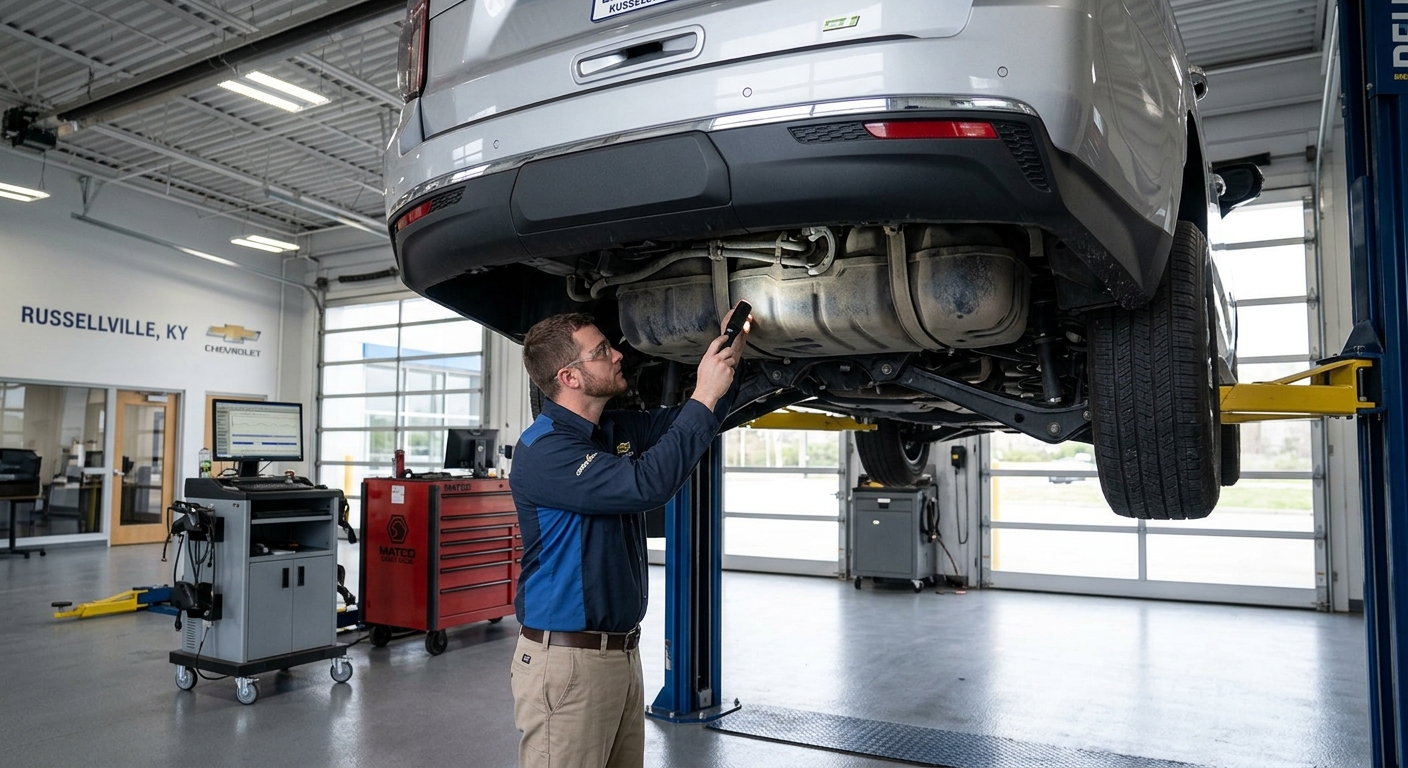
The process of replacing a fuel tank on a 2023 Chevrolet Tahoe is a methodical procedure that begins with safety as the top priority. Before any bolts are turned, our technicians must relieve the fuel system’s internal pressure and disconnect the negative battery cable to eliminate any risk of sparks. The vehicle is then raised on a professional lift, and any remaining fuel is safely drained into a sealed storage container. This is a critical step, as a full 24-gallon tank weighs roughly 150 pounds, making it nearly impossible to handle safely without specialized equipment like a transmission jack.
Once the tank is drained, the technician begins disconnecting the various interfaces that allow the tank to communicate with the rest of the SUV. This includes the filler neck hose, the main fuel supply and return lines, and the electrical harness for the fuel pump module. In the 2023 Tahoe, the EVAP (Evaporative Emissions) system is also closely tied to the tank, requiring the disconnection of several vent lines that manage fuel vapors. After these are clear, the steel mounting straps are unbolted, and the tank is carefully lowered. We often find that families who use their trucks for work or heavy recreation appreciate the thoroughness of our process, and you can view our used truck inventory to see other vehicles built with this same heavy-duty architecture.
After the old tank is removed, the technician performs a transfer of components if the existing fuel pump and sensors are being reused. This involves moving the fuel pump assembly, the lock rings, and any exterior heat shields to the new tank shell. Every seal is replaced with a new gasket to ensure a vapor-tight fit. Once the new assembly is ready, it is hoisted back into position, the straps are secured to factory torque specifications, and all lines are reconnected. If you have had service with us before and would like to share your experience, please leave us a review to help other local drivers.
The final stage of the replacement involves a rigorous leak test and a system prime. We add a small amount of fresh fuel and cycle the ignition several times to build pressure in the lines, checking every connection point for even the slightest hint of a leak. We also use a diagnostic scanner to ensure the fuel level sensor is communicating correctly with the digital driver information center. To ensure your vehicle gets this level of professional attention, you can schedule a service appointment through our online portal. This ensures your Tahoe is returned to you in a condition that meets all original factory safety and performance standards.
Choosing Between Genuine OEM Parts and Aftermarket Alternatives
When faced with a fuel tank replacement, one of the most important decisions you will make is whether to use a genuine GM part or an aftermarket alternative. Genuine OEM (Original Equipment Manufacturer) parts are designed by the same engineers who built the 2023 Tahoe, ensuring that the tank’s dimensions, wall thickness, and internal baffling are identical to the original. This is particularly important for the fuel level sending unit’s accuracy; an OEM tank is guaranteed to have the correct internal geometry so that “Empty” on your gauge truly means you are out of fuel. Many owners find peace of mind in this consistency, and you can read customer testimonials to see why others choose our service center for these critical repairs.
Aftermarket fuel tanks, such as those from reputable brands like Dorman, can offer a more budget-friendly path. These parts are often made of stamped steel or high-grade plastics designed to meet or exceed the original specifications. While they are generally reliable and often come with their own warranties, they may lack some of the specific integrated features found in a factory part, such as exact heat shield mounting points or specific EVAP line clips. If you are maintaining an older vehicle or a high-mileage SUV and are looking to manage costs, an aftermarket tank can be a viable solution. For those interested in seeing our full range of available vehicles, including those with various equipment levels, you can shop our used SUV inventory online.
The warranty coverage is another factor to weigh. Genuine GM parts installed at an authorized service center typically carry a manufacturer-backed parts and labor warranty, providing protection across the country. Aftermarket parts usually carry a warranty from the part manufacturer, which may only cover the cost of the part itself and not the labor required to replace it if it fails. We always encourage a transparent conversation about these options so you can choose the one that fits your budget and your long-term plans for the vehicle.
Ultimately, the choice often comes down to how long you plan to keep the vehicle and your specific performance needs. For a 2023 model that is still relatively new, maintaining the “factory-correct” status with OEM parts can help preserve its resale value and ensure total compatibility with the vehicle’s advanced computer systems. Regardless of which path you choose, our team is dedicated to providing a professional installation that keeps your fuel system safe and reliable for years to come.
Quick Answers Before You Visit
Q: Will a fuel tank replacement fix my “Check Engine” light if it’s related to the EVAP system?
It depends on the specific code, but if the leak is originating from a cracked tank shell, a failed seal at the fuel pump, or a damaged vent nipple on the tank itself, then a replacement will resolve the issue. Our technicians perform a smoke test to confirm exactly where the vapor is escaping before recommending a full tank swap.
Q: Does the 2023 Tahoe have any active recalls for the fuel tank?
As of mid-2026, there are no widespread safety recalls specifically for the physical fuel tank shell of the 2023 Tahoe. However, some models were involved in a service campaign regarding the fuel pump power control module, which is an electronic component rather than a physical tank defect. You can learn about us and our commitment to staying updated on all manufacturer bulletins.
Q: Can I drive my Tahoe if I suspect the fuel tank is leaking?
We strongly advise against driving any vehicle with a confirmed or suspected fuel leak. Gasoline is highly flammable, and even small vapor leaks can pose a fire risk or lead to engine stalling. If you notice a strong smell of fuel or see puddles under the rear of the vehicle, you should have it towed to a professional facility immediately.
Q: Is there a difference in the fuel tank for the diesel engine versus the gasoline V8?
While the exterior dimensions and the 24-gallon capacity are generally the same, the internal components and the filler neck are specific to the fuel type. Diesel tanks must be compatible with the chemical properties of diesel fuel and are often paired with different fuel pump modules designed for the Duramax engine’s requirements.
Q: How long does the actual replacement take once the parts arrive?
Most fuel tank replacements are completed within a single business day. Once the vehicle is in the bay, the physical labor takes about 3 to 4 hours, followed by safety testing and a road test. If you are using our Newton Fastpass for a vehicle purchase, you already know we value your time, and we apply that same efficiency to our service department.
Q: Should I wait until my tank is empty before bringing it in for service?
It is helpful if the tank has a lower fuel level, as it makes the draining process faster and the tank lighter to handle. However, do not risk running out of fuel on the road; our team has the equipment to safely drain and store fuel regardless of how much is in the tank when you arrive. You can also ask about our certified pre-owned program if you are looking for a vehicle with an already-vetted fuel system.
Expert Fuel System Service at Newton Chevrolet of Russellville
Choosing the right team for a complex repair like a fuel tank replacement ensures that your vehicle remains as safe and capable as the day it left the factory. Our service center is equipped with the specialized jacks, diagnostic tools, and safety equipment required to handle high-capacity fuel systems correctly. For residents of Fort Campbell, we understand the importance of a vehicle that is ready for any mission, and we bring that same level of discipline and attention to detail to every Tahoe that enters our bays. Our technicians are factory-trained to understand the nuances of the 2023 model year, from the integration of the EVAP system to the specific torque requirements of the mounting straps.
If your current vehicle’s repair needs are making you consider a newer model, we offer a wide variety of options to suit every lifestyle. You can shop our new Chevrolet Tahoe inventory to find a fresh SUV with the latest safety tech, or if you need even more room, you might explore the Chevrolet Suburban. For those who need maximum capability for work or towing, we invite you to shop the Chevrolet Silverado HD or look at our Silverado 2500 models. We also carry a full range of family-oriented crossovers, including the Chevrolet Traverse, the Chevrolet Equinox, and the Chevrolet Blazer.
For drivers looking toward the future of transportation, we have an expanding selection of electric vehicles. You can shop the new Blazer EV, browse the Equinox EV, or even check out the Silverado EV. If you prefer something more compact, we recommend you shop the Chevrolet Trax or view the Trailblazer inventory. We also have a few remaining Chevrolet Bolt EV and Bolt EUV models for those seeking maximum efficiency. Enthusiasts can even explore our Corvette inventory, including the E-Ray, the Z06, and the ZR1.
Whether you are here for a critical repair or looking to value your trade-in toward a new Chevrolet Colorado, our team is ready to assist. We invite you to browse our full new Chevrolet inventory or explore all Chevrolet models in our showroom. When you are ready to visit, you can find our Russellville location easily from the surrounding area. For immediate assistance or to get a specific parts quote, please call us at (270) 713-3840 and let us help you get back on the road with confidence.
0 comment(s) so far on Understanding 2023 Chevrolet Tahoe Fuel Tank Replacement Costs