

What Is the Difference Between Conventional Towing and Gooseneck Towing?
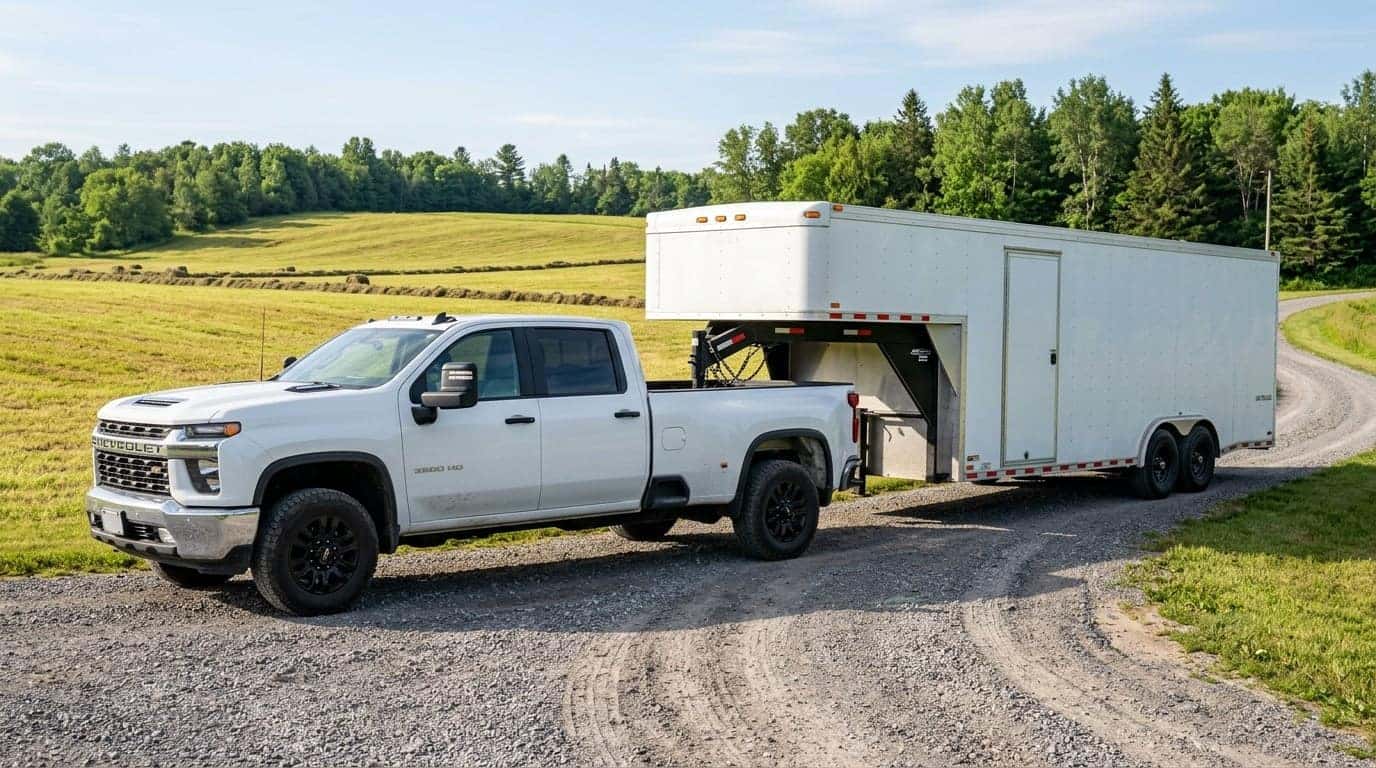
Conventional towing connects a trailer to a receiver hitch mounted below the truck’s rear bumper, whereas gooseneck towing attaches to a hitch ball installed directly inside the truck bed positioned over or slightly ahead of the rear axle. Centering the connection over the rear axle allows gooseneck hitches to transfer tongue weight straight down into the truck chassis, delivering greater directional stability, reducing sway, and supporting heavier loads than standard bumper-pull receiver setups.
Choosing between conventional bumper-pull towing and gooseneck towing depends on the type of load being moved and the vehicle platform. Conventional receiver hitches are versatile and work well for standard utility trailers, light travel trailers, and enclosed cargo setups. The coupler sits behind the rear bumper, creating a pivot point behind the rear wheels. Because this leverage point extends past the wheelbase, heavy tongue loads exert leverage on the tow vehicle, pressing down on the rear axle while lifting weight off the front steering axle unless a weight-distribution hitch is installed.
In contrast, gooseneck hitches mount directly to the truck frame beneath the bed floor. A gooseneck hitch ball sits inside the bed, coupling with a long gooseneck trailer arm that reaches over the tailgate. This configuration directs the trailer’s downward pressure straight into the rear suspension and drive axle. By eliminating the leverage effect of a bumper-pull setup, gooseneck trailering significantly reduces trailer sway caused by crosswinds or passing highway traffic. It also enables a tighter turning radius, allowing the trailer to pivot up to 90 degrees relative to the truck bed—an essential feature when maneuvering through tight work sites or farm gates.
For operators hauling agricultural machinery or livestock across rural acreage near Elkton, gooseneck trailers provide the stability required when managing heavy, shifting cargo over uneven terrain. Heavy-duty pickup trucks are specifically engineered with bed structural crossmembers to support gooseneck systems, enabling towing capacities that far exceed standard bumper receiver ratings. Drivers interested in evaluating towing options are welcome to drop by our Russellville showroom address or reach out with a quick phone call to discuss factory-installed trailering options.
Table of Contents
- What Features Are Included in a Factory Max Trailer Tow Package and What Does It Cost?
- What Is Tongue Weight and Why Is It Critical for Trailering Safety?
- Which Truck Brand Holds Its Resale Value Best for High-Capacity Towing?
- How Do You Verify Factory Tow Packages and Can Dealerships Install Them Post-Purchase?
- Common Questions About High-Capacity Towing Vehicles
- Finding High-Capacity Towing Trucks Near You
What Features Are Included in a Factory Max Trailer Tow Package and What Does It Cost?
A factory max trailer tow package equips a pickup truck with integrated mechanical and structural upgrades designed to handle heavy loads safely, including stiffer rear suspension springs, enhanced engine cooling, lower rear axle ratios, an integrated trailer brake controller, and a heavy-duty receiver hitch. Factory packages typically add between $800 and $2,500 to a vehicle’s original build price depending on the manufacturer and vehicle class.
Ordering a high-capacity tow package directly from the factory ensures that every component is integrated into the vehicle’s electrical and mechanical systems. Rather than relying on aftermarket bolt-on accessories, factory equipment coordinates directly with the engine control module and stability systems to optimize power delivery and braking response while pulling heavy loads.
Key mechanical and electronic components standard in high-capacity tow packages include:
- Enhanced Cooling Systems: Auxiliary oil coolers, larger radiators, and heavy-duty transmission fluid coolers prevent powertrain overheating during sustained hill climbs under heavy loads.
- Lower Rear Axle Ratios: Axle ratios such as 3.42, 3.73, or 4.10 multiply engine torque at the rear wheels, improving off-the-line launch power when moving massive trailer weights.
- Integrated Trailer Brake Controller: Built into the dashboard, this system communicates directly with the truck’s anti-lock braking system to modulate electric trailer brakes smoothly without lockup.
- Upgraded Suspension and Frame Crosstubes: Stiffer leaf or coil rear springs and reinforced frame crossmembers maintain ride height and prevent sagging under heavy tongue weights.
- High-Class Receiver Hitch: Class IV or Class V hitches equipped with 7-pin and 4-pin wiring harnesses and trailer sway control software integration.
Comparing factory specifications reveals how trim configurations alter towing performance. For instance, the 2026 Chevrolet Silverado 1500 lineup highlights how body style, drive configuration, and curb weight influence overall trailering capacity:
- Custom 4X4 Crew Cab Short Box: Features a curb weight of 4,950 lbs, a towing capacity of 9,000 lbs, and a payload rating of 2,050 lbs.
- Work Truck 1WT 4X4 Regular Cab Long Box: Features a curb weight of 4,750 lbs, a towing capacity of 9,300 lbs, and a payload rating of 2,150 lbs.
- High Country 4X4 Crew Cab Short Box: Features a curb weight of 5,080 lbs, a towing capacity of 9,300 lbs, and a payload rating of 1,920 lbs.
- ZR2 4X4 Crew Cab Short Box: Features a curb weight of 5,550 lbs, a towing capacity of 9,000 lbs, and a payload rating of 1,550 lbs.
Shoppers seeking pre-owned capability can explore our pre-owned pickup truck inventory to find models equipped with factory trailering packages ready for immediate work.
Dimensions & Capacity
Capacity and dimensions by trim
| Feature | Custom 4X4 Crew Cab Short Box | Custom 4X4 Crew Cab Standard Box | Custom 4X4 Double Cab Std Box | Custom Crew Cab Short Box |
|---|---|---|---|---|
| Seating | 6 | 6 | 6 | 6 |
| Curb weight | 4,950 lbs | 5,010 lbs | 4,150 lbs | 4,700 lbs |
| Towing | 9,000 lbs | 9,000 lbs | 9,000 lbs | 9,200 lbs |
| Payload | 2,050 lbs | 1,990 lbs | 2,850 lbs | 2,100 lbs |
Dimensions & Capacity (continued)
| Feature | Custom Double Cab Std Box | Custom Trail Boss 4X4 Crew Cab Short Box | Custom Trail Boss 4X4 Crew Cab Std Box | High Country 4X4 Crew Cab Short Box |
|---|---|---|---|---|
| Seating | 6 | 6 | 6 | 5 |
| Curb weight | 4,150 lbs | 5,010 lbs | 5,070 lbs | 5,080 lbs |
| Towing | 9,200 lbs | 9,000 lbs | 9,000 lbs | 9,300 lbs |
| Payload | 2,650 lbs | 1,990 lbs | 1,930 lbs | 1,920 lbs |
Dimensions & Capacity (continued)
| Feature | High Country 4X4 Crew Cab Standard Box | High Country Crew Cab Short Box | LT 2FL 4X4 Crew Cab Short Box | LT 2FL 4X4 Double Cab Std Box |
|---|---|---|---|---|
| Seating | 5 | 5 | 6 | 6 |
| Curb weight | 5,130 lbs | 4,860 lbs | 4,950 lbs | 4,940 lbs |
| Towing | 9,300 lbs | 9,500 lbs | 9,000 lbs | 9,000 lbs |
| Payload | 1,870 lbs | 1,940 lbs | 2,050 lbs | 2,060 lbs |
Dimensions & Capacity (continued)
| Feature | LT 4X4 Crew Cab Short Box | LT 4X4 Crew Cab Standard Box | LT 4X4 Double Cab Std Box | LT Crew Cab Short Box |
|---|---|---|---|---|
| Seating | 6 | 6 | 6 | 6 |
| Curb weight | 4,950 lbs | 5,010 lbs | 4,940 lbs | 4,700 lbs |
| Towing | 9,000 lbs | 9,000 lbs | 9,000 lbs | 9,200 lbs |
| Payload | 2,050 lbs | 1,990 lbs | 2,060 lbs | 2,100 lbs |
Dimensions & Capacity (continued)
| Feature | LT Crew Cab Standard Box | LT Double Cab Std Box | LT Trail Boss 4X4 Crew Cab Short Box | LT Trail Boss 4X4 Crew Cab Standard Box |
|---|---|---|---|---|
| Seating | 6 | 6 | 6 | 6 |
| Curb weight | 4,810 lbs | 4,660 lbs | 5,010 lbs | 5,070 lbs |
| Towing | 9,200 lbs | 9,200 lbs | 9,000 lbs | 9,000 lbs |
| Payload | 1,990 lbs | 2,140 lbs | 1,990 lbs | 1,930 lbs |
Dimensions & Capacity (continued)
| Feature | LTZ 4X4 Crew Cab Short Box | LTZ 4X4 Crew Cab Standard Box | LTZ Crew Cab Short Box | RST 4X4 Crew Cab Short Box |
|---|---|---|---|---|
| Seating | 5 | 5 | 5 | 6 |
| Curb weight | 5,080 lbs | 5,130 lbs | 4,860 lbs | 4,950 lbs |
| Towing | 9,300 lbs | 9,300 lbs | 9,500 lbs | 9,000 lbs |
| Payload | 1,920 lbs | 1,870 lbs | 1,940 lbs | 2,050 lbs |
Dimensions & Capacity (continued)
| Feature | RST 4X4 Crew Cab Standard Box | RST 4X4 Double Cab Std Box | RST Crew Cab Short Box | Work Truck 1WT 4X4 Crew Cab Short Box |
|---|---|---|---|---|
| Seating | 6 | 6 | 6 | 6 |
| Curb weight | 5,010 lbs | 4,940 lbs | 4,700 lbs | 4,950 lbs |
| Towing | 9,000 lbs | 9,200 lbs | 9,200 lbs | 9,000 lbs |
| Payload | 1,990 lbs | 2,060 lbs | 2,100 lbs | 2,050 lbs |
Dimensions & Capacity (continued)
| Feature | Work Truck 1WT 4X4 Crew Cab Standard Box | Work Truck 1WT 4X4 Double Cab Std Box | Work Truck 1WT 4X4 Regular Cab Long Box | Work Truck 1WT 4X4 Regular Cab Std Box |
|---|---|---|---|---|
| Seating | 6 | 6 | 3 | 3 |
| Curb weight | 5,010 lbs | 4,940 lbs | 4,750 lbs | 4,630 lbs |
| Towing | 9,000 lbs | 9,000 lbs | 9,300 lbs | 8,900 lbs |
| Payload | 1,990 lbs | 2,060 lbs | 2,150 lbs | 2,170 lbs |
Dimensions & Capacity (continued)
| Feature | Work Truck 1WT Crew Cab Short Box | Work Truck 1WT Crew Cab Standard Box | Work Truck 1WT Double Cab Std Box | Work Truck 1WT Regular Cab Long Box |
|---|---|---|---|---|
| Seating | 6 | 6 | 6 | 3 |
| Curb weight | 4,700 lbs | 4,810 lbs | 4,660 lbs | 4,510 lbs |
| Towing | 9,200 lbs | 9,200 lbs | 9,200 lbs | 9,500 lbs |
| Payload | 2,100 lbs | 1,990 lbs | 2,140 lbs | 2,290 lbs |
Dimensions & Capacity (continued)
| Feature | Work Truck 1WT Regular Cab Standard Box | ZR2 4X4 Crew Cab Short Box |
|---|---|---|
| Seating | 3 | 5 |
| Curb weight | 4,410 lbs | 5,550 lbs |
| Towing | 9,100 lbs | 9,000 lbs |
| Payload | 2,290 lbs | 1,550 lbs |
What Is Tongue Weight and Why Is It Critical for Trailering Safety?
Tongue weight is the downward static force exerted by a trailer’s coupler onto the tow vehicle’s hitch ball, and it should strictly equal 10% to 15% of the total loaded trailer weight for conventional bumper-pull setups and 20% to 25% for goosenecks. Maintaining proper tongue weight is critical because incorrect weight distribution causes violent trailer sway or unweights the front tires, severely compromising steering control and braking distance.
Calculating tongue weight requires factoring in the total loaded weight of the trailer rather than its dry weight rating. If tongue weight is too low (under 10% on a conventional hitch), the trailer becomes tail-heavy. At highway speeds, aerodynamic forces and road irregularities cause a tail-heavy trailer to oscillate side to side, creating trailer sway that can easily overwhelm the tow vehicle’s rear traction.
Conversely, excessive tongue weight places too much load on the rear axle and hitch assembly. When excessive downward force presses on the rear receiver, it pushes the rear bumper down and lifts the front end of the truck. This reduction in weight over the front axle degrades steering feedback, increases braking distance, and causes headlight beam misalignment.
To ensure safety, buyers must account for how tongue weight impacts available payload capacity:
- Calculate Total Vehicle Payload: Payload capacity includes the combined weight of all cabin passengers, truck bed cargo, aftermarket accessories, and trailer tongue weight.
- Determine Gross Vehicle Weight Rating (GVWR): The loaded truck—including its internal cargo and the trailer’s tongue weight—must never exceed the vehicle’s published GVWR.
- Verify Gross Axle Weight Rating (GAWR): Downward tongue load must not cause the rear axle weight to exceed the manufacturer’s rear GAWR.
For boaters pulling heavy marine trailers out of ramps near Scottsville around Barren River Lake, managing tongue weight ensures steer tires maintain firm pavement contact on steep inclines. Buyers seeking reliable pre-owned options can inspect our verified certified pre-owned vehicle options that feature factory-documented towing parameters.
Which Truck Brand Holds Its Resale Value Best for High-Capacity Towing?
Pickup trucks equipped with factory high-capacity tow packages and heavy-duty powertrains—particularly Chevrolet Silverado 1500 and Silverado HD models—consistently retain high resale value due to commercial demand, durable frame engineering, and reliable engine designs. Factory trailering options preserve long-term resale value significantly better than aftermarket add-ons because second-hand buyers value factory-backed gross combination weight ratings.
Resale value in the towing segment is driven by structural durability and mechanical longevity. Commercial buyers, agricultural operators, and recreational trailering enthusiasts actively seek pre-owned trucks that feature factory-installed cooling systems, heavy-duty transmissions, and integrated brake controls. Vehicles equipped with high-torque engines, such as the Duramax 3.0L Turbo-Diesel or heavy-duty V8 powerplants, command top dollar on the pre-owned market due to their towing efficiency and extended service life.
To protect resale value over time, truck owners should follow strict maintenance guidelines when towing heavy loads regularly:
- Transmission Fluid Service: Heavy towing subjects transmission fluid to elevated operating temperatures; changing fluid at recommended heavy-duty service intervals preserves clutch health.
- Differential and Axle Care: Replacing gear oil in high-stress rear axles prevents differential wear under high-torque trailering demands.
- Brake System Maintenance: Inspecting rotors, pads, and trailer brake wiring prevents premature wear caused by heavy stopping loads.
Owners considering upgrading their tow vehicle can value your trade-in online to see current market demand for high-capability trucks, or schedule a service appointment with our technicians to keep existing factory towing equipment operating at peak efficiency.
How Do You Verify Factory Tow Packages and Can Dealerships Install Them Post-Purchase?
Factory tow packages can be verified by inspecting the vehicle’s original Monroney window sticker, requesting a manufacturer VIN build-sheet lookup, or checking the driver-side doorjamb Trailering Information Label. While dealership service departments can install receiver hitches, wiring harnesses, and trailer brake controllers post-purchase, aftermarket additions cannot increase a truck’s factory Gross Combined Weight Rating (GCWR) or published maximum towing limit.
The Trailering Information Label located on the driver-side B-pillar provides vehicle-specific trailering specs directly from the assembly plant. This label explicitly lists the truck’s GVWR, GCWR, maximum payload rating, rear GAWR, and maximum allowable tongue weight. Verifying these numbers on the physical vehicle ensures buyers do not rely on generic marketing charts that may assume different cab configurations, axle ratios, or package options.
While a dealership parts department can install genuine factory hitches and brake modules after purchase, the vehicle’s official GCWR remains fixed to its original factory build specification. The factory rating is calculated based on structural frame reinforcements, axle assembly specs, cooling capacity, and factory brake sizing. Adding a Class IV receiver hitch to a truck built without a max tow package enables it to carry a receiver mount, but it does not raise the vehicle’s structural weight rating or legal towing threshold.
Comparing powertrain specifications across the 2026 Chevrolet Silverado 1500 lineup illustrates how factory configurations dictate performance:
- Custom 4X4 Crew Cab Short Box: Powered by a 2.7L engine generating 310 hp and 430 lb-ft torque, paired with a Hydra-Matic transmission and All-wheel drive.
- High Country 4X4 Crew Cab Short Box: Powered by a 5.3L engine generating 355 hp and 383 lb-ft torque, paired with a Hydra-Matic transmission and All-wheel drive.
- ZR2 4X4 Crew Cab Short Box: Powered by a 3L engine producing 305 hp and 495 lb-ft torque, paired with a Hydra-Matic transmission and All-wheel drive.
Buyers exploring tow-ready options can browse our selection of new Chevrolet trucks, submit a credit application online, or consult our genuine parts department for certified trailering accessories.
Engine & Performance
Powertrain specs by trim
| Feature | Custom 4X4 Crew Cab Short Box | Custom 4X4 Crew Cab Standard Box | Custom 4X4 Double Cab Std Box | Custom Crew Cab Short Box |
|---|---|---|---|---|
| Engine | 2.7L | 2.7L | 2.7L | 2.7L |
| Horsepower | 310 hp | 310 hp | 310 hp | 310 hp |
| Torque | 430 lb-ft | 430 lb-ft | 430 lb-ft | 430 lb-ft |
| Transmission | Hydra-Matic | Hydra-Matic | Hydra-Matic | Hydra-Matic |
| Drivetrain | All-wheel drive | All-wheel drive | All-wheel drive | Rear-wheel drive |
Engine & Performance (continued)
| Feature | Custom Double Cab Std Box | Custom Trail Boss 4X4 Crew Cab Short Box | Custom Trail Boss 4X4 Crew Cab Std Box | High Country 4X4 Crew Cab Short Box |
|---|---|---|---|---|
| Engine | 2.7L | 2.7L | 2.7L | 5.3L |
| Horsepower | 310 hp | 310 hp | 310 hp | 355 hp |
| Torque | 430 lb-ft | 430 lb-ft | 430 lb-ft | 383 lb-ft |
| Transmission | Hydra-Matic | Hydra-Matic | Hydra-Matic | Hydra-Matic |
| Drivetrain | Rear-wheel drive | All-wheel drive | All-wheel drive | All-wheel drive |
Engine & Performance (continued)
| Feature | High Country 4X4 Crew Cab Standard Box | High Country Crew Cab Short Box | LT 2FL 4X4 Crew Cab Short Box | LT 2FL 4X4 Double Cab Std Box |
|---|---|---|---|---|
| Engine | 5.3L | 5.3L | 2.7L | 2.7L |
| Horsepower | 355 hp | 355 hp | 310 hp | 310 hp |
| Torque | 383 lb-ft | 383 lb-ft | 430 lb-ft | 430 lb-ft |
| Transmission | Hydra-Matic | Hydra-Matic | Hydra-Matic | Hydra-Matic |
| Drivetrain | All-wheel drive | Rear-wheel drive | All-wheel drive | All-wheel drive |
Engine & Performance (continued)
| Feature | LT 4X4 Crew Cab Short Box | LT 4X4 Crew Cab Standard Box | LT 4X4 Double Cab Std Box | LT Crew Cab Short Box |
|---|---|---|---|---|
| Engine | 2.7L | 2.7L | 2.7L | 2.7L |
| Horsepower | 310 hp | 310 hp | 310 hp | 310 hp |
| Torque | 430 lb-ft | 430 lb-ft | 430 lb-ft | 430 lb-ft |
| Transmission | Hydra-Matic | Hydra-Matic | Hydra-Matic | Hydra-Matic |
| Drivetrain | All-wheel drive | All-wheel drive | All-wheel drive | Rear-wheel drive |
Engine & Performance (continued)
| Feature | LT Crew Cab Standard Box | LT Double Cab Std Box | LT Trail Boss 4X4 Crew Cab Short Box | LT Trail Boss 4X4 Crew Cab Standard Box |
|---|---|---|---|---|
| Engine | 2.7L | 2.7L | 2.7L | 2.7L |
| Horsepower | 310 hp | 310 hp | 310 hp | 310 hp |
| Torque | 430 lb-ft | 430 lb-ft | 430 lb-ft | 430 lb-ft |
| Transmission | Hydra-Matic | Hydra-Matic | Hydra-Matic | Hydra-Matic |
| Drivetrain | Rear-wheel drive | Rear-wheel drive | All-wheel drive | All-wheel drive |
Engine & Performance (continued)
| Feature | LTZ 4X4 Crew Cab Short Box | LTZ 4X4 Crew Cab Standard Box | LTZ Crew Cab Short Box | RST 4X4 Crew Cab Short Box |
|---|---|---|---|---|
| Engine | 5.3L | 5.3L | 5.3L | 2.7L |
| Horsepower | 355 hp | 355 hp | 355 hp | 310 hp |
| Torque | 383 lb-ft | 383 lb-ft | 383 lb-ft | 430 lb-ft |
| Transmission | Hydra-Matic | Hydra-Matic | Hydra-Matic | Hydra-Matic |
| Drivetrain | All-wheel drive | All-wheel drive | Rear-wheel drive | All-wheel drive |
Engine & Performance (continued)
| Feature | RST 4X4 Crew Cab Standard Box | RST 4X4 Double Cab Std Box | RST Crew Cab Short Box | Work Truck 1WT 4X4 Crew Cab Short Box |
|---|---|---|---|---|
| Engine | 2.7L | 2.7L | 2.7L | 2.7L |
| Horsepower | 310 hp | 310 hp | 310 hp | 310 hp |
| Torque | 430 lb-ft | 430 lb-ft | 430 lb-ft | 430 lb-ft |
| Transmission | Hydra-Matic | Hydra-Matic | Hydra-Matic | Hydra-Matic |
| Drivetrain | All-wheel drive | All-wheel drive | Rear-wheel drive | All-wheel drive |
Engine & Performance (continued)
| Feature | Work Truck 1WT 4X4 Crew Cab Standard Box | Work Truck 1WT 4X4 Double Cab Std Box | Work Truck 1WT 4X4 Regular Cab Long Box | Work Truck 1WT 4X4 Regular Cab Std Box |
|---|---|---|---|---|
| Engine | 2.7L | 2.7L | 2.7L | 2.7L |
| Horsepower | 310 hp | 310 hp | 310 hp | 310 hp |
| Torque | 430 lb-ft | 430 lb-ft | 430 lb-ft | 430 lb-ft |
| Transmission | Hydra-Matic | Hydra-Matic | Hydra-Matic | Hydra-Matic |
| Drivetrain | All-wheel drive | All-wheel drive | All-wheel drive | All-wheel drive |
Engine & Performance (continued)
| Feature | Work Truck 1WT Crew Cab Short Box | Work Truck 1WT Crew Cab Standard Box | Work Truck 1WT Double Cab Std Box | Work Truck 1WT Regular Cab Long Box |
|---|---|---|---|---|
| Engine | 2.7L | 2.7L | 2.7L | 2.7L |
| Horsepower | 310 hp | 310 hp | 310 hp | 310 hp |
| Torque | 430 lb-ft | 430 lb-ft | 430 lb-ft | 430 lb-ft |
| Transmission | Hydra-Matic | Hydra-Matic | Hydra-Matic | Hydra-Matic |
| Drivetrain | Rear-wheel drive | Rear-wheel drive | Rear-wheel drive | Rear-wheel drive |
Engine & Performance (continued)
| Feature | Work Truck 1WT Regular Cab Standard Box | ZR2 4X4 Crew Cab Short Box |
|---|---|---|
| Engine | 2.7L | 3L |
| Horsepower | 310 hp | 305 hp |
| Torque | 430 lb-ft | 495 lb-ft |
| Transmission | Hydra-Matic | Hydra-Matic |
| Drivetrain | Rear-wheel drive | All-wheel drive |
Common Questions About High-Capacity Towing Vehicles
Q: What documentation should I check on the doorjamb before hitching up a heavy trailer?
Every truck includes a Trailering Information Label and a Tire and Loading Information Label inside the driver-side doorjamb. Buyers should check the specific Gross Vehicle Weight Rating (GVWR), Gross Combined Weight Rating (GCWR), rear Gross Axle Weight Rating (GAWR), and maximum payload limit listed on those stickers. Comparing those precise factory figures against the trailer’s scale weight ensures the tow vehicle stays within legal operating limits.
Q: How does cooling equipment in a tow package protect engine performance under heavy loads?
Factory max tow packages add dedicated auxiliary transmission fluid coolers and higher-capacity engine cooling radiators to maintain optimal fluid temperatures. Towing heavy loads up steep grades forces the engine and transmission to operate under sustained high load, generating heat that breaks down standard lubricants. Auxiliary cooling circuits dissipate heat continuously, preventing thermal degradation and transmission slippage.
Q: What tire load ratings should I look for when hauling maximum payload or heavy tongue weights?
Vehicles hauling heavy tongue weights or high payload require tires with adequate load index ratings, often moving from standard Passenger (P-metric) tires to Light Truck (LT) metric tires with E-load ratings. LT tires feature reinforced sidewalls that resist flexing under heavy downward forces, maintaining tread stability, lowering running temperatures, and improving highway tracking when pulling high-capacity trailers.
Q: How do rear axle ratios directly impact towing capacity and highway fuel economy?
A numerically higher rear axle ratio, such as 3.73 or 4.10, multiplies engine torque to the drive wheels, allowing the truck to accelerate heavy loads from a stop with less engine strain. However, higher gear ratios cause the engine to run at elevated RPMs at highway speeds, slightly lowering empty fuel economy. Lower ratios like 3.23 improve highway fuel economy when empty but lower maximum trailer capacity.
Q: How does online pre-qualification simplify buying a high-capacity tow vehicle?
Completing an online pre-qualification allows buyers to establish their financing terms, estimate monthly budget targets, and verify purchase power before visiting the lot. Knowing your financing structure upfront speeds up the showroom process and helps buyers focus directly on choosing trucks equipped with the specific factory tow packages and payload ratings required for their equipment needs.
Shoppers interested in exploring certified options can learn about Newton Certified pre-owned benefits, streamline their transaction using the Newton Fastpass digital shopping experience, or learn more about our team and dealership commitments.
Finding High-Capacity Towing Trucks Near You
Selecting a truck capable of hauling heavy machinery, livestock, or camper trailers requires matching your trailer weight requirements against verified factory ratings for payload, axle strength, and gross combination weight limits. Newton Chevrolet of Russellville stocks a full lineup of light-duty and heavy-duty trucks built to manage demanding trailering applications safely and efficiently.
Our team provides transparent vehicle specs, straight answers on tow ratings, and real numbers up front so you can choose the exact powertrain, axle ratio, and package configuration required for your haul. Whether you need a daily driver capable of pulling a weekend boat or a heavy-duty gooseneck rig for daily commercial work, we ensure your truck is properly equipped before you hitch up.
To take the next step, visit our showroom at 452 Hopkinsville Rd to review window stickers and doorjamb trailering labels in person, or give our vehicle specialists a call at (270) 713-3840 to schedule a tow-vehicle test drive today.
0 comment(s) so far on What Is the Difference Between Conventional Towing and Gooseneck Towing?