

How Do the 2027 Tahoe Police Fleet 2WD and 4WD Compare in Power and Drivetrain Capability?
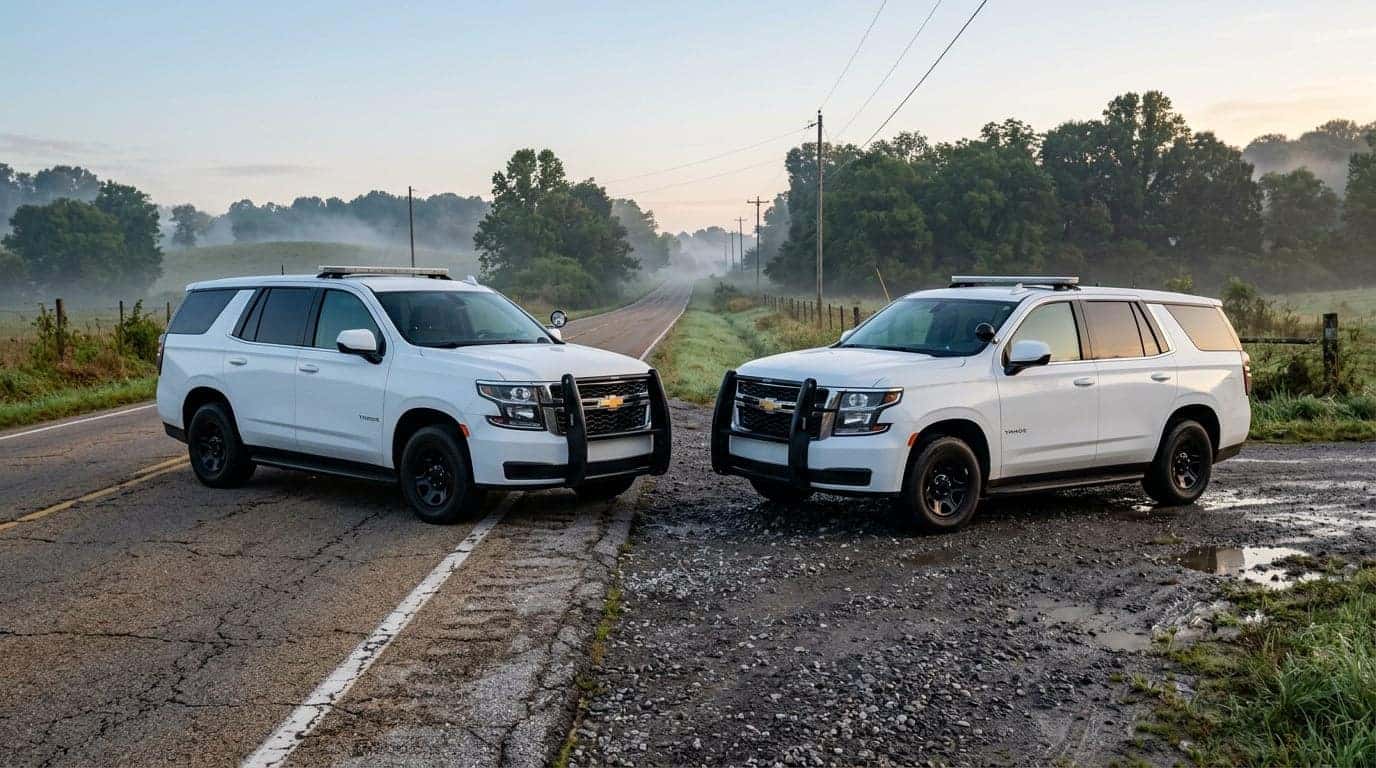
Both the two-wheel-drive and four-wheel-drive configurations of the 2027 Chevrolet Tahoe Police Pursuit Vehicle share identical engine performance, utilizing a standard 5.3L EcoTec3 V8 paired with a heavy-duty 10-speed automatic transmission. This powertrain produces 355 hp at 5,600 rpm and 383 lb-ft of torque at 4,100 rpm. The functional difference lies strictly in power distribution: two-wheel-drive models send torque exclusively to the rear wheels for lower curb weight and maximum high-speed efficiency, whereas four-wheel-drive models add an Autotrac two-speed transfer case and an electronic limited-slip differential to distribute output to all four wheels during low-traction pursuits or off-pavement operations.
When municipal agencies and fleet managers compare drivetrain options, power output is rarely the deciding factor because the output figures do not change between drive systems. Instead, mechanical traction strategy separates the two choices. The 2WD Police Fleet layout provides immediate throttle response on dry asphalt while reducing parasitic drivetrain drag. This configuration serves patrol routes exceptionally well where high-speed highway response dominates daily operations.
By contrast, the 4WD Police Fleet model uses Chevrolet’s active transfer case to allow full-time automatic four-wheel drive engagement along with driver-selectable low-range gearing. When officers transition from paved highways to unpaved shoulder paths or wet grass during emergency responses, the system shifts torque automatically to prevent rear-wheel slippage. Patrol units near Fort Campbell North frequently operate across a mix of paved suburban corridors, open state routes, and perimeter access paths, making dynamic torque distribution a key operational asset.
For fleet directors evaluating pursuit-rated vehicles or setting up delivery schedules, our team provides straight answers without sales scripts or hidden steps. You can reach out to give our team (270) 713-3840 a call or visit our showroom on Hopkinsville Road to review active fleet spec sheets and ordering timelines.
Table of Contents
- What Are the Ground Clearance and Suspension Differences Between 2WD and 4WD Tahoe Police Vehicles?
- Is 4WD or 2WD Better Suited for Police Fleet Operations and Pursuit Handling?
- How Do State Police Testing Results Compare 2WD vs 4WD Tahoe Performance?
- How Much More Does a Fleet Spend on Fuel Annually for 4WD vs 2WD Tahoes?
- Does the 2027 Tahoe PPV Come Equipped with Autonomous Emergency Braking and Specialized Safety Tech?
- Common Questions About 2027 Chevrolet Tahoe Police Drivetrains
- Selecting and Equipping Your Fleet
What Are the Ground Clearance and Suspension Differences Between 2WD and 4WD Tahoe Police Vehicles?
The 4WD 2027 Tahoe PPV features a slightly higher static ride height and enhanced ground clearance compared to the 2WD PPV, giving it an advantage when driving over curbs, debris, or unpaved terrain. However, both versions utilize a lowered, police-calibrated suspension setup with heavy-duty springs, specialized performance-tuned shocks, thick front and rear stabilizer bars, and heavy-duty Brembo front brakes designed specifically to control body roll and sustain high-speed police maneuvers.
Ground clearance differences stem directly from the front axle setup and transfer case packaging. The 2WD variant sits lower to the ground, which drops the center of gravity and increases aerodynamic efficiency under high-speed pursuit conditions. The lower ride height helps stabilize the vehicle during rapid lane changes or aggressive slalom maneuvers on dry pavement.
The 4WD variant trades a fraction of that low-slung stance for underbody clearance. That extra height protects key driveline components when a patrol officer needs to hop a median or cross rough fields during an emergency call. The chassis suspension remains heavily reinforced across both platforms to handle the extra payload of police hardware, interior partitions, radar units, and heavy tactical gear.
- 2WD Suspension Profile: Lower ride height, reduced body roll on flat pavement, lower center of gravity, and lighter overall curb weight.
- 4WD Suspension Profile: Slightly elevated stance, increased obstacle clearance for medians and rough shoulders, paired with an Autotrac two-speed transfer case.
- Shared Chassis Hardware: Heavy-duty Brembo front brakes with six-piston monoblock calipers, police-calibrated coil-over-shock front suspension, and police-rated tires.
For departments comparing law enforcement fleet inventory alongside retail options, our team maintains up-to-date information across all configurations. You can browse our current new Chevrolet Tahoe inventory or review our selection of pre-owned vehicle options to see how Chevrolet full-size utility platforms fit your operational budget.
The gently rolling topography around Springfield includes a mix of paved county roads, agricultural access routes, and gravel lanes. Agencies patrolling these rural-suburban routes often weigh the lower ride height of the 2WD against the extra ground clearance of the 4WD to select the right chassis for their specific geographic beat.
Is 4WD or 2WD Better Suited for Police Fleet Operations and Pursuit Handling?
The 2WD Tahoe PPV is generally better suited for high-speed highway patrol on dry pavement due to its lighter overall weight and lower center of gravity, while the 4WD Tahoe PPV is superior for all-weather response, sudden weather shifts, mud, snow, and rough off-road terrain. Choosing between them depends on whether an agency prioritizes dry-track pursuit dynamics or absolute year-round operational mobility.
Pursuit handling on dry pavement heavily favors the 2WD model. Without the front differential, transfer case, and front drive axles, the 2WD Tahoe carries less mass over the front wheels. This reduction in unsprung weight yields sharper turn-in response, crisper steering feel, and slightly higher top-speed capabilities during extended highway chases.
Conversely, the 4WD Tahoe PPV eliminates the single biggest vulnerability of a high-powered rear-wheel-drive SUV: rear-wheel traction loss on slick surfaces. When responding to calls in heavy rain, sleet, or loose gravel, the 4WD system dynamically transfers engine torque to the front wheels before rear spin can destabilize the vehicle. This capability provides officers with immediate acceleration out of intersections or off shoulder stops without waiting for traction control to cut engine power.
Agencies adding utility vehicles to their support fleet can also explore Newton Certified pre-owned inventory, which provides comprehensive warranty protection and detailed inspection coverage for pre-owned fleet choices.
How Do State Police Testing Results Compare 2WD vs 4WD Tahoe Performance?
In standardized vehicle evaluation testing conducted by the Michigan State Police, 2WD Tahoe PPV models typically record slightly faster lap times and shorter stopping distances on dry asphalt, whereas 4WD Tahoe PPV models outperform 2WD units in standing-start acceleration on low-friction surfaces. The performance delta on dry pavement comes down to curb weight differences, where the 2WD model’s weight advantage translates directly into acceleration and cornering benefits.
On closed-course pursuit simulation testing, evaluation drivers report that the 2WD Tahoe PPV exhibits neutral handling characteristics with minimal understeer when entering high-speed corners. The lower mass allows the heavy-duty braking system to shed speed slightly faster, reducing brake pad temperatures over repeated hard-braking cycles.
However, acceleration testing on wet or degraded surfaces flips these results entirely. While a rear-wheel-drive unit may experience wheelspin before traction management intervenes, the 4WD model engages its active transfer case to launch cleanly. For agency mechanics and fleet maintenance supervisors maintaining these high-stress braking and drivetrain systems, proper routine upkeep is critical to preserving pursuit ratings. Local departments can easily schedule a service appointment with our factory-trained technicians to keep routine maintenance on schedule.
| Performance Metric | 2WD Tahoe PPV | 4WD Tahoe PPV |
|---|---|---|
| Drivetrain Layout | Rear-Wheel Drive | Active Four-Wheel Drive |
| Dry Pavement Lap Times | Marginally Faster | Baseline |
| Dry Braking Distance | Slightly Shorter | Baseline |
| Low-Traction Launch Acceleration | Standard Traction Control | Superior (4WD Engaged) |
| Front-End Mass | Lighter | Heavier (Front Axle & Transfer Case) |
How Much More Does a Fleet Spend on Fuel Annually for 4WD vs 2WD Tahoes?
Assuming an average of 25,000 patrol and pursuit miles driven per vehicle annually, a fleet typically spends roughly $500 to $750 more per year in fuel for each 4WD Tahoe PPV compared to a 2WD model. The 2WD 5.3L V8 carries an EPA rating of 15 mpg city / 20 mpg highway / 17 mpg combined, while the 4WD 5.3L V8 is rated at 15 mpg city / 19 mpg highway / 17 mpg combined.
The slight drop in highway fuel economy for the 4WD variant stems from two primary factors: the mechanical friction of the extra drivetrain components and the added vehicle weight of the transfer case and front differential. Over a standard four-year or 100,000-mile fleet lifecycle, that fuel variance accumulates to approximately $2,000 to $3,000 per unit depending on local bulk fuel prices.
For municipal budget committees balancing fuel allocations against equipment needs, factoring in these real fuel figures up front prevents unexpected operating deficits later. Departments trading in older support vehicles or retiring pursuit units to offset initial acquisition costs can use our online resource to value your trade-in and secure real numbers before finalizing fleet purchases.
Does the 2027 Tahoe PPV Come Equipped with Autonomous Emergency Braking and Specialized Safety Tech?
The 2027 Chevrolet Tahoe PPV comes equipped with standard law-enforcement-calibrated active safety features, including Enhanced Automatic Emergency Braking, Front Pedestrian Braking, Forward Collision Alert, Lane Keep Assist, Blind-Zone Steering Assist, and Rear Cross-Traffic Alert. These systems are specifically programmed to assist officers during high-stress patrol maneuvers without interfering with authorized tactical driving procedures.
Unlike consumer-grade safety suites that can overreact to close-proximity maneuvers, the active safety technology on the Tahoe PPV accounts for the unique operating environment of emergency vehicles. The Enhanced Automatic Emergency Braking system operates from 5 mph upward, using forward-looking radar and camera sensors to detect impending frontal impacts with vehicles, pedestrians, or cyclists, providing visual and audible alerts before applying hard emergency braking if necessary.
- Enhanced Automatic Emergency Braking: Provides forward collision detection and automated braking intervention tailored for fleet operation.
- Blind Zone Steering Assist: Monitors rear quarter blind spots and applies subtle steering pressure if a lane change is initiated into an occupied lane.
- Rear Cross-Traffic Alert: Uses radar sensors to detect approaching traffic when reversing out of driveways or hidden access lanes.
- HD Surround Vision: Displays a high-resolution 360-degree overhead view of the vehicle’s immediate perimeter for tight maneuvering.
Municipal purchasing agents planning department expansions or updating operational equipment can streamline the acquisition process by applying for financing online to complete preliminary approval before taking delivery.
Common Questions About 2027 Chevrolet Tahoe Police Drivetrains
Q: Do the 2WD and 4WD 2027 Tahoe PPV models use different engines?
No, both the 2WD and 4WD 2027 Chevrolet Tahoe PPV models feature the same standard 5.3L EcoTec3 V8 engine producing 355 hp and 383 lb-ft of torque, mated to a 10-speed automatic transmission. Power output and engine specs are identical across both drivetrain configurations.
Q: What transfer case is installed on the 4WD Tahoe PPV?
The 4WD Tahoe PPV uses an Autotrac two-speed transfer case featuring automatic four-wheel drive mode, high-range four-wheel drive, low-range four-wheel drive, and two-wheel drive high settings, paired with an electronic limited-slip differential for optimal traction.
Q: Is the 2WD Tahoe PPV fast enough for highway pursuit duty?
Yes, the 2WD Tahoe PPV is specifically engineered for pursuit duty. Its lighter weight and lower ride height give it excellent top-speed capability, sharp cornering stability, and short stopping distances on paved roads, making it a primary choice for highway patrol agencies.
Q: Does the 4WD Tahoe PPV offer higher towing capacity than the 2WD model?
When properly equipped, the 2WD Tahoe PPV actually offers a slightly higher maximum towing capacity of up to 8,400 lbs, whereas the 4WD model is rated for up to 8,200 lbs due to the added weight of the four-wheel-drive mechanical components.
Q: How can departments manage maintenance and ownership tools online?
Agencies and fleet managers can manage vehicle options and research vehicle protection programs through our online tools. You can learn more about Newton’s certified pre-owned program, or choose to explore Newton Fastpass to streamline the purchasing process entirely online. To learn more about our commitment to simple, transparent vehicle sales, feel free to read more about us.
Selecting and Equipping Your Fleet
Choosing between the 2WD and 4WD 2027 Chevrolet Tahoe PPV comes down to matching drivetrain mechanics to your department’s geographical terrain and operational mandates. The 2WD model delivers maximum efficiency, lower acquisition costs, and outstanding dry-pavement handling for highway enforcement. The 4WD model provides all-weather capability, increased obstacle clearance, and complete traction confidence on unpaved roads and severe weather patrols.
Our team is dedicated to providing straight answers, clear specs, and transparent process guidance for every fleet order. When you are ready to evaluate chassis specifications or order official accessories, visit our Russellville location, call our team at (270) 713-3840, or get in touch directly with our parts department to equip your fleet for the road ahead.
0 comment(s) so far on How Do the 2027 Tahoe Police Fleet 2WD and 4WD Compare in Power and Drivetrain Capability?